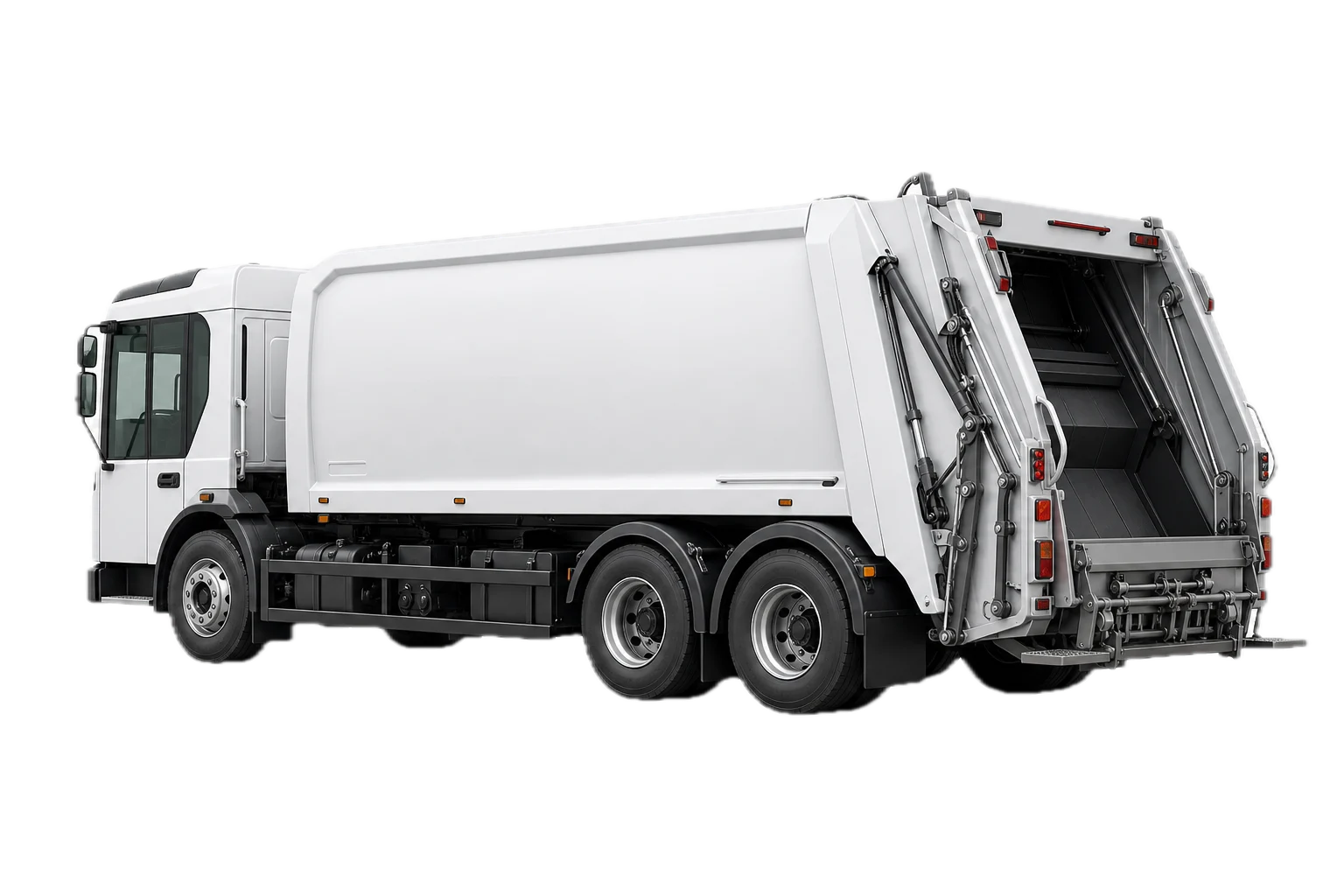
Rear-loading refuse lorries, recycling vehicles and collection fleets
WHY REFUSE IS DIFFERENT
Low mileage. High exposure.
A refuse vehicle covers fewer miles than an artic and meets more hazards per mile than almost anything else on the road. The risk is in the round, not the odometer.
01
Reversing on every street.
Cul-de-sacs, closes and turning heads mean reversing several times an hour. WISH guidance calls reversing a high-risk activity to be eliminated where possible and minimised where it is not, and notes it has historically been the main cause of fatalities in the sector.
02
A crew working at the rear.
Loaders work within touching distance of the hopper and the bin lift, often in the blind spot immediately behind the rave rail. WISH WASTE 04 treats rear-view CCTV as a supplementary aid rather than a primary one, which is exactly why its condition on the day matters.
03
The public a metre away.
School-run traffic, cars parked on both sides, cyclists filtering past on the nearside and residents crossing behind the vehicle. Most incidents involve a third party, and most disputes come down to who saw what and whether anyone can show it.
Sources: HSE, Work-related fatal injuries in Great Britain 2025/26, published 1 July 2026, recording 5.47 fatal injuries per 100,000 workers in waste and recycling against 0.37 across all industries. WISH WASTE 04, Safe operation of waste and recycling collection vehicles, September 2019.
RECON ON THE ROUND
Predict the risk. Prevent the collision. Prove what happened.
The same three streams as the rest of the MANTIS platform, tuned to what a refuse round throws at a driver and a transport manager.
Predict
Collision Likelihood, weighted for the round.
Each vehicle and driver is scored against the fleet, weighted by the multipliers that matter on a refuse round: reversing frequency, time of day, weather and street density. Scores are relative comparisons that tell you where to look first. They are not a forecast that a collision will happen.
Prevent
Alerts that reach the driver in time.
In-cab alerts flag pedestrians and cyclists in the nearside zone, close following and distraction as they happen. Alerts support the driver judgement and the crew safe system of work. They do not replace either, and they do not guarantee prevention.
Prove
Every camera, one moment, minutes later.
When a resident claims a wing mirror, a driver claims a scrape or a loader is hurt, the Evidence Centre pulls footage from every camera around the moment with telemetry alongside.
Risk scores in RECON examples are shown out of 15 and use demo data. A harsh brake may be defensive driving: review footage, context and the driver account before drawing a conclusion, and never let a score alone decide an employment, underwriting or liability outcome. On Demand retrieval depends on power, connectivity and retention settings.
THE QUESTIONS THAT MATTER
A view of your everyday challenges.
01
A missed-collection complaint
Use time and location context to find available video from the round.
02
A damage allegation
Review the relevant camera angles instead of relying on conflicting accounts.
03
A camera covered in road grime
Use health reporting and physical lens checks together; not every obstruction is a device failure.
CAMERA COVERAGE
One system around the whole vehicle.
A typical rear-loader configuration puts cameras where a refuse round actually goes wrong: ahead, down both sides, across the rear working area and, if you choose, in the cab.
Forward. Road ahead, following distance, junction approaches and the car that pulls out in front of a stopping vehicle.
Nearside and offside. Cyclists filtering, parked cars, kerb strikes and mirror clips on streets that were never built for a 2.5-metre body.
Rear and hopper area. Reversing, loaders at the rave rail and the bin-lift zone, with the footage kept for when a question is asked.
In cab, optional. Driver-facing camera for distraction and fatigue detection, with privacy settings agreed with your drivers before it goes live.
Camera positions, counts and AI detections depend on the configuration selected for each vehicle type. Ask us about side loaders, food waste vehicles and hook loaders, which need a different layout.
Privacy-edited marketing example from a UK/Ireland installation. Not a specification of native image quality. Actual camera layout is agreed for your vehicles.
MANTIS HEALTH
Know the rear camera works before the crew clocks on.
WISH guidance is blunt: if the rear-view CCTV fails, the collection vehicle should be taken out of service. Finding that out at the first cul-de-sac costs a missed round and a crew standing around.
Live diagnostics
Every camera, recorder and connection, fleet-wide, in one view.
Fault alerts
Naming the vehicle, the camera and the time, so the workshop knows what to look at.
Warranty replacement
Handled inside the MANTIS as a Service subscription, so a failed unit is a ticket, not a purchase order.
Offline is not proof of camera failure. Monitoring or power alone does not guarantee useful recording or retrievable footage. Whether a vehicle with a reported fault continues its round is a decision under your own safe system of work.
REGULATION AND GUIDANCE
Built with DVS and WISH in mind.
Refuse fleets answer to more than the Highway Code. RECON is designed to sit inside the frameworks you already work to, not to replace them.
DIRECT VISION STANDARD
Working inside Greater London.
HGVs over 12 tonnes operating in Greater London need a Direct Vision Standard permit. Since 28 October 2024 that means a three-star rating or a fitted Progressive Safe System.
If your RCVs work inside the boundary, ask us how a RECON configuration fits alongside your PSS approach.
PSS compliance depends on the equipment fitted and Transport for London current requirements. MANTIS does not certify DVS star ratings.
WISH WASTE 04
Supplementary to the safe system, never a substitute.
WISH treats rear-view CCTV as a supplementary aid to trained reversing assistants and safe systems of work. RECON is built to respect that: better visibility for the driver, faster answers for the transport manager, and camera health you can evidence to an inspector or an insurer.
Where WISH asks for reversing to be designed out, the route and event data shows you which streets and which times are driving the reversing count.
Reversing aids and CCTV do not remove the need for a risk assessment, trained reversing assistants or route design. Guidance is subject to change; check the current WISH and HSE publications.